OnRamp vs GuideCX
The GuideCX Alternative Built for Customer Experience, Not Complexity
If you're considering switching from GuideCX, you're likely seeking more customization, deeper collaboration tools, and a simpler, more intuitive user experience. That's where OnRamp stands out.
B2B Customer & Revenue leaders trust OnRamp
OnRamp helps you scale reach and results, without sacrificing a personalized customer experience.
"We chose OnRamp for its customizability and integrations - transforming onboarding with efficiency, visibility, and personalized experiences."
Lance Walton, Director of Client Experience
![]()
LOOKING FOR JUST ANOTHER INTERNAL ALIGNMENT TOOL?
GuideCX was built for internal teams - with the customer experience as an afterthought.
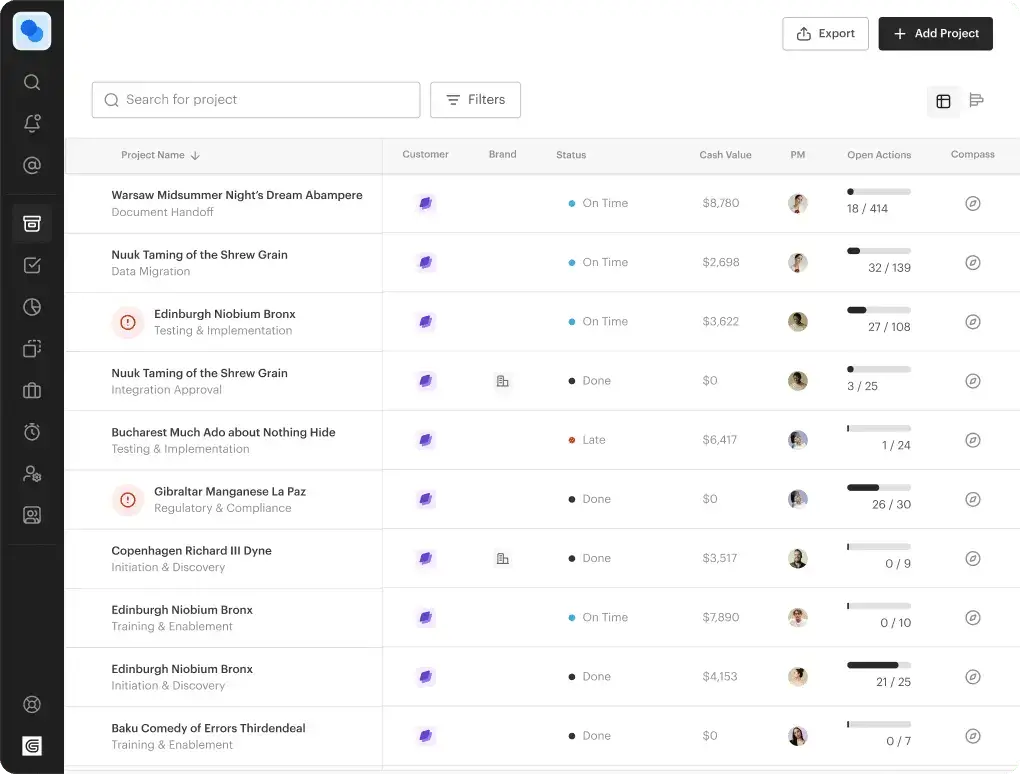
GuideCX boasts a feature-heavy internal interface while lacking the simplicity end users need to keep momentum. Our customers who have switched tell us they chose OnRamp for a better end customer experience and more intuitive UI.
Here's why you, too, might be interested in a GuideCX alternative:
You want your customer at the center of onboarding – from start to finish
You want a user friendly customer portal that drives engagement
You want higher adoptions rates across your products
You want a simple internal interface that brings clarity - not clutter - to your workflows
You need to scale your onboarding without manual, ad-hoc tasks
How is OnRamp different than GuideCX?
OnRamp is purpose-built for mid-to-large organizations that rely on Customer Success to drive revenue and retention. Unlike other tools that add friction, OnRamp helps teams create and keep momentum – from kickoff to training, implementation, and adoption. OnRamp delivers faster time-to-value, smoother launches, and happier customers.
|
OnRamp |
GuideCX |
|
|
Product Structure |
One platform with both a customer-facing portal and internal project management |
Disparate products and tools, only available based on how much you spend |
|
Primary Focus |
Customer onboarding and user experience |
Internal project management functionality |
|
Ease of Adoption |
Built with the end customer in mind; high adoption |
Less intuitive; cluttered, feature-heavy interface |
|
Customer Support |
CSM access and guidance available on all tiers |
Pooled support (dedicated CSM only available on higher-tier plans) |
|
Customer Portal |
Designed for end-customer adoption, reducing friction |
Primary focus on internal project tracking |
What is the difference between OnRamp and GuideCX?
GuideCX is an internal project management tool with a customer-facing layer. OnRamp is purpose-built for customer onboarding and engagement. The core difference is who the platform is designed for: GuideCX prioritizes internal team workflows and task tracking, while OnRamp prioritizes the end-customer experience with an intuitive portal, automated engagement workflows, and real-time visibility that helps teams reduce time-to-value by up to 70%.
Why do teams choose OnRamp over GuideCX?
Teams evaluating GuideCX alternatives choose OnRamp for three main reasons: (1) OnRamp’s client portal is designed for end-customer adoption, not just internal tracking — customers actually use it. (2) OnRamp offers deeper customization for customer-facing communications and onboarding flows. (3) OnRamp is simpler to adopt — G2 reviewers frequently cite GuideCX’s cluttered interface and limited customization as challenges.
How does GuideCX pricing work?
Like many software platforms, GuideCX pricing is determined by a combination of functionality and licenses needed. According to their website, pricing starts at $5,000, but 3P data from Vendr shows an average price of ~$26,500 (based on 16 deals).
How long does it take to switch from GuideCX to OnRamp?
Most teams are fully up and running with OnRamp within 30 days. OnRamp is designed for fast implementation with intuitive setup, pre-built templates, and a dedicated onboarding team to help you migrate. OnRamp focuses on getting your team and your customers live as quickly as possible.
Does GuideCX have a customer-facing portal?
GuideCX does offer a customer-facing portal, but it’s only available on the Advanced tier and above. G2 reviewers note that GuideCX’s portal can feel complex for end customers, and communication features are limited — customer messages only reach one team member rather than the full team. OnRamp’s client portal is included on all plans and is specifically designed for end-customer engagement, with a clean interface that drives task completion and reduces the need for manual follow-ups.