Quick Answer: The best Rocketlane alternatives depend on what you're trying to solve. For teams focused on customer onboarding, OnRamp is the strongest purpose-built option — combining playbooks, customer-facing portals, and Aero AI that automates follow-up and flags stalled accounts. For teams evaluating PSA tools for billable services delivery, Kantata, Ruddr, and Certinia are the closest alternatives. For lightweight project management without dedicated onboarding features, Monday.com and Asana. The right choice comes down to whether your primary need is customer-facing onboarding, professional services automation, or general project management.
Key Takeaways
- Rocketlane has repositioned as a full PSA platform — if you're evaluating it for customer onboarding, you'll find most of the PSA layer goes unused while you still pay for it. Purpose-built onboarding tools like OnRamp, GuideCX, and EverAfter cover the use case more directly.
- The customer onboarding tool landscape has shifted significantly in 2025-2026: Arrows pivoted to AI sales execution, EverAfter was acquired by Base.ai, and Rocketlane went all-in on PSA.
- The biggest differentiator between onboarding tools in 2026 is AI — specifically whether it handles proactive account monitoring (flagging stalled accounts, re-engaging customers automatically) or just automates email reminders. These are meaningfully different capabilities.
- Before evaluating any alternative, get clear on three things: whether you bill clients for the onboarding work, how many concurrent onboardings your team manages, and whether your customers need their own portal experience.
Rocketlane is now a full PSA platform. They've added timesheets, resource planning, rate cards, invoicing, and margin tracking to what started as a customer onboarding tool. If you're a professional services team that bills clients for implementation work, that evolution makes sense. If you're a CS team running post-sale onboarding, most of that goes unused while you still pay for it.
This guide covers the 6 best Rocketlane alternatives in 2026, organized by use case, so you can find the right fit without evaluating tools built for a different problem than yours.
What kind of buyer are you?
Before comparing tools, it helps to know which use case you're actually solving:
- Customer onboarding: You're getting customers from "deal closed" to "fully live." No timesheets, no rate cards — just a structured process, a customer-facing portal, and automation to keep onboarding moving. OnRamp, GuideCX, and EverAfter are built for this.
- Billable services delivery (PSA): You're a professional services or implementation team that invoices clients for the work. Resource planning, margin tracking, and invoicing need to sit next to the project plan. Kantata, Ruddr, and Certinia are the right category.
- General project management: You want task tracking and project structure without a dedicated onboarding or PSA tool. Monday.com and Asana cover this, with tradeoffs on the customer-facing experience.
6 Best Rocketlane Alternatives in 2026
1. OnRamp
Best for: Teams running structured, repeatable customer onboarding at scale — without adding headcount.
OnRamp is a customer onboarding platform built for teams managing post-sale onboarding. It replaces the spreadsheets, email chains, and manual follow-ups most teams rely on with a structured platform that runs onboarding consistently across every account.
Aero AI, OnRamp's agentic AI layer, monitors every active onboarding simultaneously, flags accounts that are stalling, and automatically re-engages customers who go quiet, without a CSM having to manually check in. Your team defines the playbook once; the platform runs it at scale.
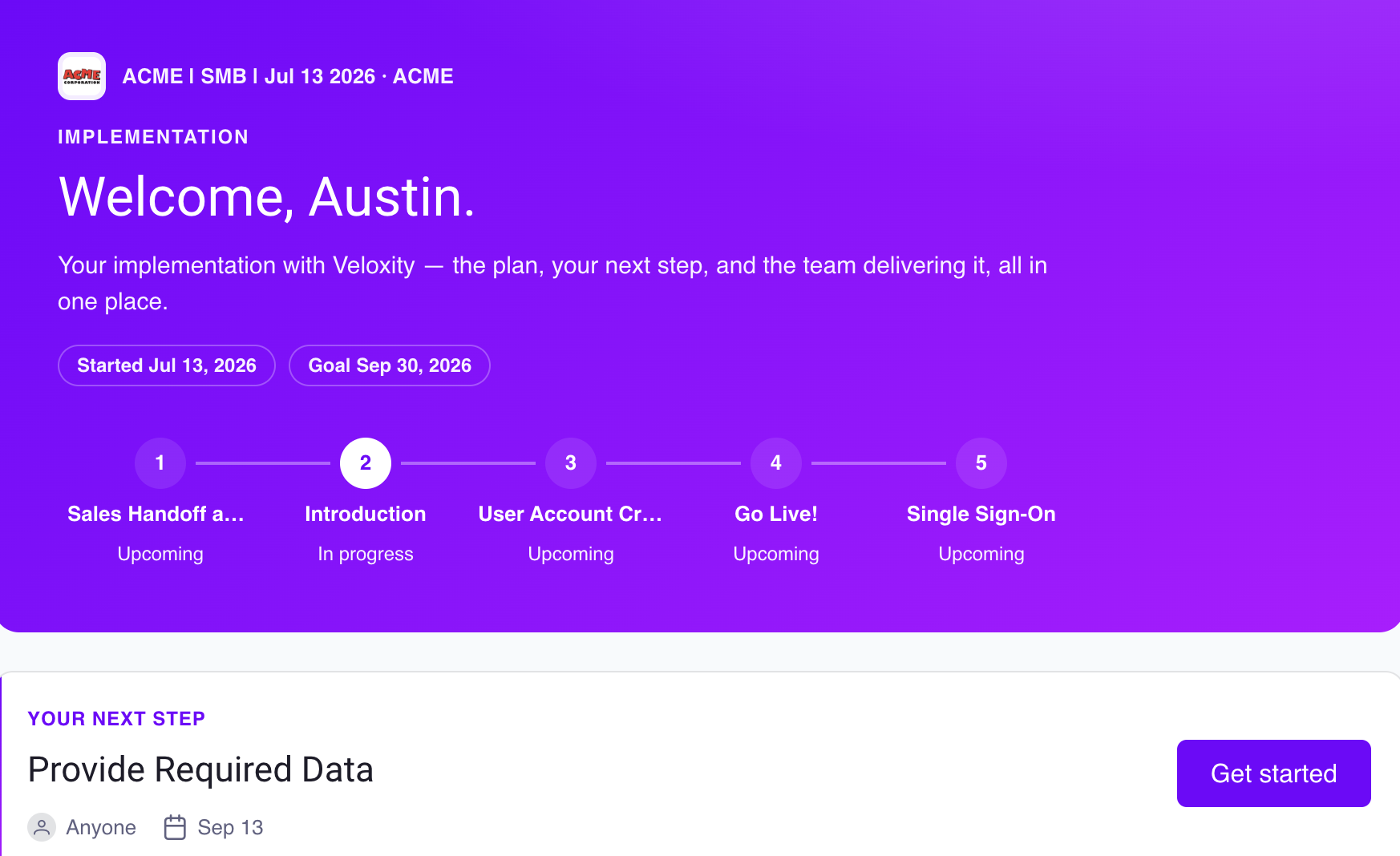
Customers get a branded portal showing their tasks, milestones, and progress in real time. It replaces the status-check emails that slow onboarding down. Native Salesforce and HubSpot integrations mean a closed deal automatically creates an onboarding project, and milestone data flows back into your CRM.
Pros:
- Purpose-built for customer onboarding (not a PSA, not a general PM tool)
- Aero AI handles proactive account monitoring and re-engagement automatically
- Branded customer portals included across all plans
- Native Salesforce and HubSpot integrations with bi-directional sync
- Pre-built playbook templates; most teams are live within 30-60 days
Cons:
- Not the right fit if you need PSA features like timesheets, invoicing, or resource planning
- No self-serve free tier; sandbox demo environment available upon request
2. GuideCX
Best for: Teams that want structured implementation management with strong dependency control, project governance, and detailed reporting across large volumes of concurrent projects.
GuideCX is a customer onboarding and implementation platform, not a PSA. Their positioning centers on project transparency and accountability: customers and internal teams share a workspace where every task, milestone, and stakeholder responsibility is visible in real time.
GuideCX leans into dependencies-first project structure. Tasks gate each other based on predecessors, giving implementation teams tight control over sequencing in complex, multi-phase deployments.
Pros:
- Strong dependency management for complex, multi-phase implementations
- Detailed project reporting for teams managing high volumes of concurrent onboardings
- Customer-facing project portal with task transparency
Cons:
- Steep learning curve; initial setup and customization require significant time investment
- Performance can lag on large or complex projects
- Built primarily for the onboarding phase; post-go-live task management is limited
3. EverAfter AI
Best for: Teams that want a single branded hub covering the full customer lifecycle, from onboarding through adoption, QBRs, and renewals, with a digital CS motion.
EverAfter AI (now part of Base.ai) is a digital customer success platform that creates customer-facing hubs spanning onboarding, adoption, success plans, business reviews, and renewal. It's built for the full post-sale lifecycle, giving every account a persistent, AI-personalized workspace that evolves as the relationship matures.
If your team is trying to scale customer success beyond onboarding — running QBRs, tracking adoption milestones, and managing renewals — EverAfter's scope covers the full lifecycle. If your primary bottleneck is getting customers live faster in the first 30-90 days, a more narrowly focused onboarding tool is likely a better fit.
Pros:
- Full lifecycle CS: onboarding → adoption → QBRs → renewals in one platform
- AI personalization across every customer account at scale
- Strong for digital CS motions managing large books of accounts
Cons:
- UX has a learning curve; new users often find the content structure confusing initially
- Customization within widgets (fonts, layout, style) is more limited than the overall flexibility suggests
- Reporting and analytics are less robust than dedicated CS platforms
4. Kantana
Best for: Mid-market to enterprise professional services firms that need a full PSA inlcuding resource forecasting, utilization tracking, project financials, and billing — all in one platform.
Kantata (formerly Mavenlink + Kimble) is a PSA platform built for agencies, consulting firms, and professional services organizations managing complex, multi-resource engagements. It covers resource planning, project delivery, time tracking, and financial management in one system — with the depth to handle utilization reporting, margin tracking, and revenue forecasting at scale.
For teams evaluating Rocketlane as a PSA, Kantata is the heavier-weight option, with more configuration, longer implementation, but more depth on resource planning and financial management.
Pros:
- Deep resource planning with skills-based matching and capacity forecasting
- Full financial management: budgets, margins, revenue recognition, and invoicing in one system
- Granular time tracking with notes and detailed logging
Cons:
- Steep learning curve; requires dedicated training and ongoing admin support
- HubSpot integration is limited; the enhanced connector for custom objects comes at additional cost
- Starts at $45/user/month, significantly more expensive than Rocketlane
5. Ruddr / Certinia
Best for: PSA alternatives when Kantata is too large or too expensive. Ruddr for mid-sized services teams, Certinia for Salesforce-native organizations.
ClickUp is an all-in-one project management solution whose feature set, including CRM capabilities, allows you to create a comprehensive customer portal. The platform's customization options and collaboration features enable you to tailor workflows to your clients' needs. Despite the wide toolset, the reporting may not be as in-depth as some may like.
Ruddr is the modern, lighter-weight PSA for small to mid-sized professional services teams. It covers projects, tasks, time and expense tracking, resource allocation, budgets, and invoicing in a simpler interface with faster setup than enterprise incumbents.
Certinia (formerly FinancialForce) is the Salesforce-native PSA option. Built directly on Salesforce, it's the natural choice for organizations that run their entire business in the Salesforce ecosystem and want PSA that shares data natively with their CRM without an integration layer.
Both are built for delivery teams that invoice clients for implementation work.
6. Monday.com / Asana / ClickUp
Best for: Teams with very simple onboarding needs or those not ready to invest in dedicated onboarding software.
General project management tools are sometimes considered as Rocketlane alternatives, particularly by early-stage teams looking to reduce costs. For internal task management and basic project structure, they work. For customer-facing onboarding, the limitations are real: no branded customer portal, no onboarding-specific automation, no CRM-deep sync, and no account health monitoring.
Your customers end up with a guest seat in your internal tool rather than a dedicated onboarding experience, and your team ends up manually doing what a purpose-built tool would handle automatically.
Pros:
- Low cost; most teams already pay for at least one
- Flexible enough for basic onboarding workflows internally
- Familiar interface; low adoption friction for your team
Cons:
- Clients access shared board views inside your workspace rather than a dedicated branded portal
- No onboarding automation or account health monitoring
- No native CRM sync designed for onboarding use cases
How to choose the right Rocketlane alternative?
Do you bill clients for the onboarding work? If yes, you need PSA. Evaluate Kantata, Ruddr, or Certinia. If no, a purpose-built onboarding platform covers more of what you actually need without PSA overhead.
How many concurrent onboardings is your team managing? If it's more than 10-15 at once, manual tracking breaks down fast. Look for a tool with health monitoring, automated nudges, and a portfolio view. OnRamp and GuideCX both handle this. General PM tools don't.
Do your customers need their own experience? If customers have tasks to complete and milestones to hit, they need a branded portal, not a guest seat in your internal tool. OnRamp, GuideCX, and EverAfter all provide this. Monday and Asana don't.
How important is AI that monitors accounts proactively? There's a difference between AI that generates content and AI that actively watches your onboarding pipeline and intervenes when accounts go quiet. OnRamp's Aero AI is built for the latter. If proactive account monitoring matters, evaluate on that specifically.
See how OnRamp compares to Rocketlane specifically: OnRamp vs. Rocketlane | Book a demo
Frequently Asked Questions
.svg "Clip path group (1)")


.svg)
.svg)
.svg)


.svg)
.svg)
.png)
.svg)


.svg)
.svg)
.svg)